INTRODUCTION
12 desembre 2010 by anesica
As I’ve mentioned before in the abstract, this time my work won’t be based on William Blake’s life or the time in which he lived (The Romanticism). It will be focused on the analysis of three of his poems. I considered that it would be interesting for the reader that these three chosen ones belong to different time of William Blake’s life.
We don’t have to forget the topic of both works: «William Blake’s uniqueness». If you have read the first paper, you will have realised why he was so «unique». He was not only a poet, but also a revolutionary and visionary artist. He was perceived as an independent artist in a time where reason was very important. He was as well a man with passionately held beliefs on religion, philosophy, politics, morality, and art whose propagation was the purpose of his writings. All these characteristics are, then, reflected in his poems.
Blake’s most popular work was «Songs of Innocence and Experience». «Innocence» and «Experience» are definitions of conciousness that rethink Milton’s existential-mythic states of «Paradise» and the «Fall». In one hand, with the noun «Innocence» he refers to the childhood which is a time and state of protected «innocence», not immune to the institutions. On the other, «Experience» refers a state of being marked by the loss of childhood vitality, by fear and inhibition, by social and political corruption, and by the manifold oppression of Church, State, and the ruling classes. As it was explained in the first paper, William Blake opposed to tyranny wherever he found it and a distrust of authority whether it be represented in kings, priests or even in the very idea of a monolithic deity who rules human affairs.

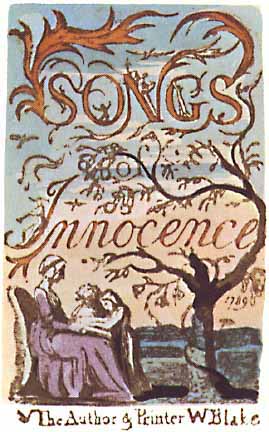
«Songs of Innocence» it is a collection of 19 poems, engraved with artwork. I chose to work on «A Cradle Song». I thought there was not a better example for explaining children’s innocence. It shows us why William Blake was considered so great, so «unique».
On the other hand, I decided to work on «The Tyger» since it is one of the most notable poems in «Songs of Experience». As I explained in the first paper, I was introduced to it in Ireland when a friend of mine who is a well-known jeweler and graver showed me a plat he has made based on this poem. (You can see it here: http://www.imaxenes.com/imagen/dibujo1kx96vg.jpg.html)

Furthermore, our Poetry’s teacher spoke about it when he introduced us William Blake so I felt an extremely admiration for this poem.

The third chosen poem is «Jerusalem», the symbolic residence of a humanity freed of the inter-related chains of commerce, British imperialism, and war.

In the conclusion you will be able to find the main ideas, my impressions and my own conclusion.